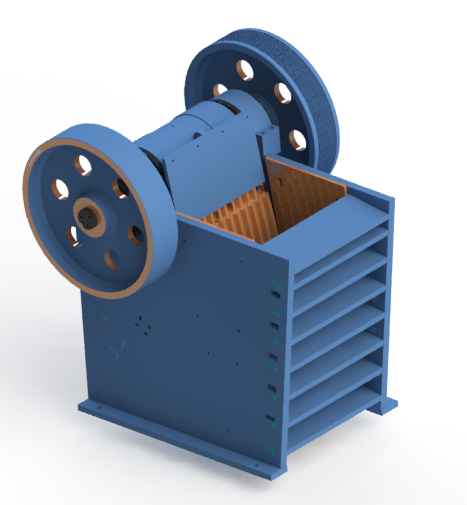
Cheek plates
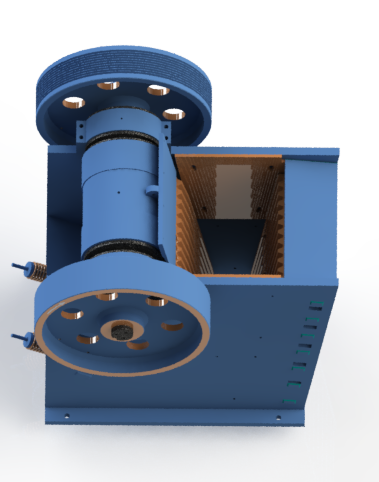
Cheek plates are also made of manganese steel. They are in two parts, so that the lower part, which takes most of the wear, can be replaced separately.
Toggle
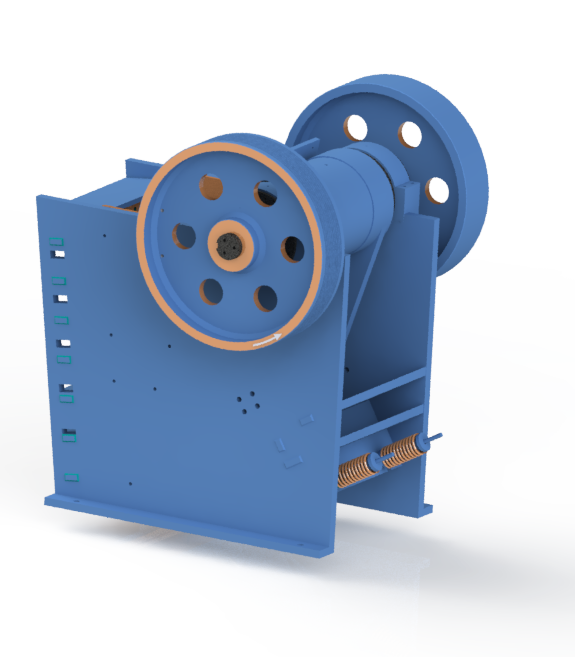
Toggle of this crusher is made of accrete steel plates in proper thickness or made of steel casting. The proper length of toggle designing for this kind of crusher causes the best angle between fixed toggle and moving toggle, not over than standard length, so it avoids throwing rocks out.
Bearing arrangement
The roller bearings are of the spherical type which adjusts themselves to the deflection of the shaft. They are protected by labyrinth seals which are designed with minimum play and effectively prevent dust and dirt from penetrating into the bearings and grease from being forced out. On this crusher the frame bearings are mounted in replaceable housings which are in turn secured in recesses in the frame with bearing caps.
Adjusting
Device The function of the adjusting device is to compensate for wear on the jaw plates, toggle seats and toggle plate and to provide minor adjustment of the discharge opening. The adjusting wedge is raised or lowered by means of the adjusting bolts and the horizontal movement of the groove block is followed by the toggle plate and moving jaw, thus altering the discharge opening of the crusher. Adjustment can be carried out while the crusher is in motion. For major alterations of the discharge opening, a longer or shorter toggle plate is fitted. Toggle plates are available in various standard lengths. The above methods of adjustment can be used only within certain limits. If the lower section of the moving jaw is advanced too far towards the fixed jaw plate the nip angle will be too great and the material. With the aid of a third method of adjustment it is, however, possible to make large alterations of the discharge opening without affecting the nip angle. This is done by inserting a thicker or thinner shim behind the fixed jaw plate. Shims are available in various standard thicknesses. Changing the shim thickness behind the fixed jaw plate also alters the feed opening at the top. To obtain the largest possible opening no thicker shim should be used than that required with regard to a suitable nip angle.